Loa Waka Medium Grind Kava, Kenya
Loa Waka Medium Grind Kava, Kenya
Couldn't load pickup availability
Loa Waka Medium Grind Kava, Kenya
Fiji's Benchmark Kava. Strong, Balanced, and Built for Any Hour.
Loa Waka is the kava Fijians bring to ceremonies, serve to guests as a mark of respect, and drink at community gatherings that have been running the same way for centuries. The name tells you something important straight away: waka refers to the lateral roots of the plant, which is where kavalactone concentration peaks, and that distinction matters more than most people realise. Most of the potency difference between a genuinely strong kava and a mediocre one comes down to which part of the root was used. Loa Waka uses the best part.
For Kenyans looking to cut back on alcohol or replace it entirely in social settings, Loa Waka is the variety that covers that ground most convincingly. You get the social ease and the stress relief you'd get from a drink, without the hangover, the empty calories, or the foggy morning after.
Time to Notice Effects: 15-20 Minutes (Peak effects at 1.5-2 hours)
Perfect For:
Friday evening wind-down | Social gatherings and group sessions | Post-work stress relief without alcohol | Morning, afternoon, or evening use | Experienced kava drinkers wanting full potency | Anyone reducing or replacing alcohol
Available In:
30g | 60g | 120g |
Don't want to deal with preparation? We can prepare it for you. Just reach us on WhatsApp at +254 702 251 255, tell us how many grams you want prepared, and we'll handle everything from start to finish. You receive ready-to-drink kava, no strainer bag, no kneading, no mess.
Product Specifications
Active Ingredient
100% Noble Medium Grind Kava Root, Loa Waka cultivar from Fiji. Kavain-dominant chemotype 423561. Lateral (waka) roots only, with no stems, stumps, leaves, or fillers.
Other Ingredients
None. Pure kava root only.
Quality Certifications
Certified Noble kava, third-party tested for kavalactone content and purity, with verified Loa Waka cultivar status from established Fijian farms. No tudei contamination.
What is Loa Waka Kava?
If you're new to kava altogether, the short version is this: kava is a plant from the Pacific Islands whose root gets processed into a powder, prepared with water, and drunk as a relaxation beverage that produces genuine calm without alcohol and without any of alcohol's side effects. No hangover, no calories, no disrupted sleep, no next-morning fog. Our guide on what kava is and its benefits covers this in full if you want the deeper background.
Loa Waka is Fiji's benchmark variety and the highest-potency kava in our range. The waka grading distinction is the foundation of Fiji's entire kava reputation. Waka is lateral roots, lewena is stump material, and waka always commands a premium because the kavalactone concentration in lateral roots significantly outpaces stump material. When a kava product doesn't specify its grade, it's usually lewena or a blend. Loa Waka is pure waka, and you feel that clearly once you've had both.
What Does It Actually Feel Like?
Within the first few sips, your lips and tongue go slightly numb or tingly. This is caused by kavain interacting with nerve endings in your mouth, it's completely normal, and it's actually a good sign the kavalactones are present and working. About 15-20 minutes in on an empty stomach, mental relaxation sets in. The background stress of the day fades, thoughts settle, and social conversation comes more easily. The body component follows, and the two effects run together rather than one replacing the other. By the 90-minute mark, you're in the full session with both mental and physical relaxation at their peak, and the experience tapers gradually over the following 2 hours without an abrupt drop. Our article on what kava feels like goes into more detail if you want to understand the full experience before trying it.
Most people describe Loa Waka as deeply relaxing but clear, which is the quality that makes it work so well as an alcohol alternative. You're present and engaged through the whole session rather than progressively numbed the way alcohol works.
Why Loa Waka Over a Beer or a Drink?
Alcohol produces its social ease by suppressing brain function broadly, and you pay for that with disrupted sleep, a cortisol spike that leaves you anxious by morning, dehydration, and empty calories. Loa Waka works through specific kavalactone interactions with GABA receptors and sodium channels that produce calm without suppressing mental clarity. The result is that you feel relaxed and present at the same time rather than progressively numbed.
Practically speaking, a Loa Waka session means no hangover the next day, no spike in anxiety by morning, no empty calories, and no next-day regret. For people who enjoy the social ritual of drinking but are unhappy with what alcohol does to their sleep, their waistline, or their productivity the day after, Loa Waka is a direct replacement that doesn't feel like a compromise.
How It Works
The Science Behind the Experience
Kavain is the primary compound in Loa Waka's chemotype and it crosses the blood-brain barrier quickly, slowing neural firing through sodium channel action. That's the mechanism behind the clear-headed quality: you're relaxed and mentally present at the same time rather than fogged out. Dihydrokavain sits second in the chemotype and modulates GABA receptors, which is where the anti-anxiety and muscle relaxation effects come from. Your nervous system slows down in a controlled, predictable way, and because the waka grade starts you at a higher kavalactone concentration per gram, the effects are noticeably stronger than lower-grade kava at an equivalent dose.
Effect Timeline
During the first 20 minutes, mouth numbing begins during preparation and the first shell, with initial mental softening following shortly after. Between 20 and 45 minutes, the heady phase is fully underway: work stress drops, mood lifts, and conversation comes easily. From 45 minutes to the two-hour mark, both mental and physical relaxation are running together, with body heaviness building gradually without tipping into sedation at standard doses. After that, the session sustains and tapers slowly over the following two hours, with sleep becoming accessible if you want it but not imposing itself if you're still socialising.
How to Prepare Loa Waka
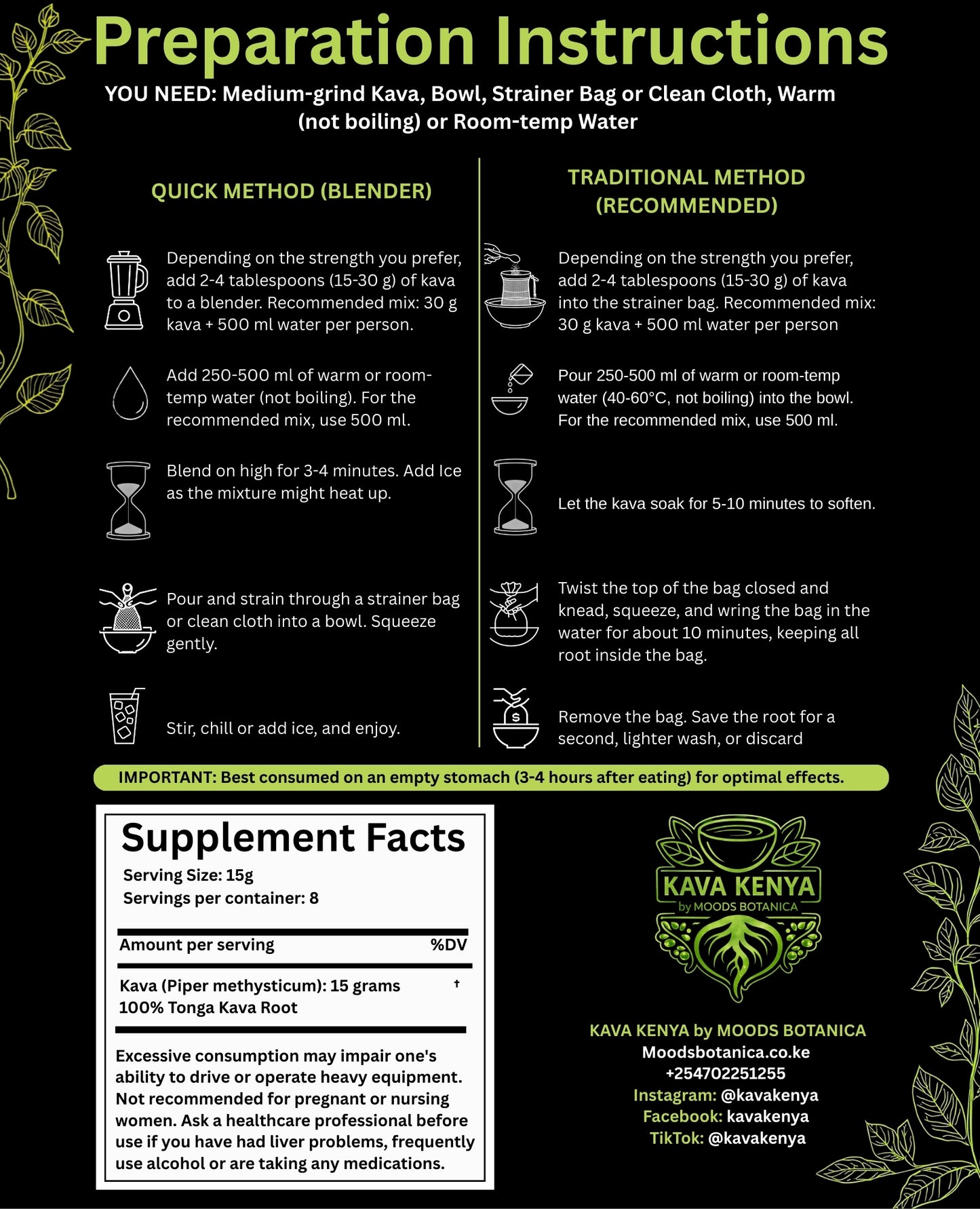
We've covered every preparation method in detail, from the traditional strainer method to the blender shortcut, in our full guide: How to Make Kava (Without Making a Mess). The ratios, timing, water temperature rules, and first-timer tips are all there.
The key points for Loa Waka specifically: use 30-35g (about 4-6 tablespoons) per 500ml of water as your starting ratio, and always consume on an empty stomach or at least 3-4 hours after a meal since food significantly slows kavalactone absorption. For the traditional kneading method, room temperature or slightly warm water (40-60°C) works best. For the blender method, use cold or room temperature water only, since blending already generates heat and warmer water produces a bitter, degraded result. Give it a full 30 minutes before deciding whether to drink another shell.
Prefer to skip all of that? Message us on WhatsApp at +254 702 251 255, tell us how many grams you'd like prepared, and we'll take care of the whole process for you.
Dosing and Session Pacing
A standard starting dose is 30g (4-6 tablespoons) per 500ml for one session. Prepare one full batch and pace yourself over 1-3 shells, each about 100-150ml, spaced 15-20 minutes apart. Loa Waka is the strongest kava in our range, so starting at the lower end of that dose on the first session is the right approach. Kavain works fast enough that you'll have a clear read on where you are before the next shell, making it easy to reach your target level without overshooting.
Stay Hydrated
Kava is a diuretic, much like coffee, so it's worth drinking a glass of water between shells throughout your session. Staying hydrated helps you avoid the dry skin and mild headache that some people experience the next morning and keeps the session comfortable from start to finish.
Yield Guide by Pack Size
- 30g: a single session for one person, the right size for a first try before committing to a larger bag.
- 56.5g: 1-2 sessions, useful for exploring the variety across a couple of evenings and getting past the reverse tolerance phase.
- 113g: approximately 4 standard sessions, a good monthly supply for someone drinking at moderate frequency.
- 226g: approximately 8 standard sessions, the best value per gram for those who've confirmed Loa Waka is their variety.
What To Expect as a New Kava Drinker
For a first session, keep it at home on a quiet evening, start at the standard 30g dose, and give it at least 30 minutes before assessing. Loa Waka is the strongest kava in our range, and a conservative first session gives you an accurate read on how your body responds before adjusting. Some people also experience reverse tolerance, where effects strengthen over the first three to five sessions as the body calibrates to kavalactones. If the first session feels underwhelming, give it two more tries before increasing your dose.
How Loa Waka Fits Into the Kava Kenya Range
Loa Waka vs Borongoru:
Borongoru is purpose-built for deep evening relaxation and sleep support. It goes heavy fast and builds toward rest, and it does that job extremely well. Loa Waka is stronger overall but stays balanced, so you get full-spectrum effects without being pushed toward bed before you're ready. Use Borongoru when sleep is the specific goal. Use Loa Waka when you want a full session that works on your schedule.
Loa Waka vs Borogu:
Borogu has a built-in progression where it starts heady and transitions to heavy over 4-6 hours, making it well suited to a specific afternoon-to-evening arc. Loa Waka stays balanced from start to finish and hits harder at equivalent doses. The choice comes down to whether you want a kava that takes you somewhere in a specific direction, or one that holds its character throughout the session. Browse Borogu to compare.
Loa Waka vs Palarasul and Kelai:
Both Palarasul and Kelai are euphoric, uplifting kavas that sit lighter than Loa Waka in terms of intensity and body effect. They're excellent choices for daytime use or for drinkers who want something social without the full-spectrum depth that Loa Waka delivers. If you're new to kava, starting with either of those before moving up to Loa Waka is a reasonable path.
Loa Waka vs Pouni Ono:
Pouni Ono is uplifting and light, with no body sedation at any dose. It's a focused daytime kava suited to mornings or productive afternoons. Loa Waka is considerably more potent and delivers both the heady and physical dimensions together. They serve different purposes: Pouni Ono for daytime clarity and energy, Loa Waka when you want the full kava experience.
Safety Information
Consult a Healthcare Provider Before Use If:
You take medications processed by the liver, have a history of liver conditions, are pregnant or breastfeeding, take sedatives, anti-anxiety medications, antidepressants, or sleep aids, or have surgery scheduled within the next two weeks.
Do Not Combine With:
Alcohol, sedative medications, anti-anxiety medication, sleep aids, muscle relaxants, or antidepressants without medical guidance. Kava and alcohol together significantly amplify sedation and should be avoided entirely.
Driving Warning:
Do not drive or operate machinery after consuming kava. Effects run a minimum of 4-6 hours and impairment is real regardless of how clearheaded you feel during the euphoric phase. Plan your transport before the session, not after.
Potential Side Effects:
Mild nausea from consuming on a full stomach, dizziness at high doses, dry and scaly skin with extended daily use, and temporary motor impairment are the most commonly reported effects.
When to Stop and Seek Medical Attention:
Yellowing of the skin or eyes, unusual fatigue or weakness, dark urine, pale stools, or persistent nausea and stomach pain all require immediate medical review and permanent discontinuation of kava.
Frequently Asked Questions
Is kava legal in Kenya?
Yes. Kava is a botanical plant product with no classification as a controlled substance under Kenyan law. Kava Kenya imports and sells kava legally, and every batch is third-party tested for purity and kavalactone content before it reaches customers.
I've never tried kava before. Is Loa Waka the right starting point?
Loa Waka is the strongest variety in our range, so if you're completely new to kava, starting with Kelai or Borogu gives you a gentler introduction before stepping up. That said, plenty of first-time customers start with Loa Waka at a conservative 30g dose and find it perfectly manageable. If you're unsure, reach us on WhatsApp at +254 702 251 255 and we'll help you choose based on what you're looking for.
How fast does it hit?
Faster than heavy sedating varieties like Borongoru. Kavain-dominant kavas typically reach initial effects within 15-20 minutes on an empty stomach. If you're at the 30-minute mark and nothing is happening, the most likely explanation is a recent meal blocking absorption. Wait it out and assess at 45 minutes before adding more to your session.
Will I feel groggy the next morning?
Not at standard doses taken 2-3 hours before sleep. Kavalactones metabolise overnight and most Loa Waka users report waking clearheaded. Morning grogginess is far more associated with heavily sedating varieties taken too close to bedtime, and Loa Waka's balanced chemotype keeps it out of that category at normal doses.
How does it taste?
Earthy, peppery, and mildly bitter, though the mouth numbing that kicks in quickly during the first shell reduces taste perception significantly. Fijian kavas tend to carry less of the heavy mustiness that puts some people off Vanuatu varieties, so the flavour is slightly cleaner. Cold coconut water works well as a chaser, and after a few sessions the taste stops registering as anything worth thinking about.
How does it compare to alcohol in a social setting?
You get the social ease and stress relief without the dehydration, calorie load, or the depressive rebound that alcohol produces the next day. The experience feels more controlled: you know where you are in the effect window, coordination stays intact at standard doses, and the morning after is better by every measure. For people who have specifically switched from alcohol to kava in social settings, Loa Waka is consistently the variety they end up staying with.
Does tolerance build up?
Mild tolerance develops with daily consecutive use, typically around a 10-20% dose increase needed after a few weeks. Taking one or two days off per week keeps it minimal. New users often experience the reverse, where effects strengthen over the first three to five sessions as the body adjusts to kavalactones, so if the first session underwhelms you, give it two more tries before adjusting your dose upward.
Good for anxiety?
The mechanism is direct and well-documented. Kavain slows neural firing and dihydrokavain modulates GABA receptors, and situational anxiety and end-of-day stress are consistently where users report the clearest results. For managing an ongoing anxiety condition over the long term, talking to a healthcare provider before making kava part of your regular routine is the right approach.
How do I order?
Add Loa Waka to your cart and check out directly on this page. We deliver across Nairobi and ship to all counties in Kenya. For questions before ordering or to arrange prepared kava, reach us on WhatsApp at +254 702 251 255.
Loa Waka and Fijian Kava Culture
Sevusevu is the formal kava ceremony Fijians use to mark respect, welcome guests, open negotiations, and seal community agreements. It's performed at weddings, village meetings, and business introductions, and presenting kava and accepting it is a statement of relationship that goes back to the first Polynesian settlements in Fiji. Refusing sevusevu is a serious social breach. Loa Waka, as the premium waka-grade variety, is the quality of kava you bring to those occasions.
The ritual centres on the tanoa, the large wooden kava bowl that sits at the centre of the gathering, with the bilo, a coconut shell cup, passing around the circle in order of seniority. You clap once before receiving it, drink the full shell in one sitting, and clap three times after. The silence during drinking is deliberate, and Loa Waka has carried those sessions for generations.
Fiji's agricultural institutions enforce quality standards specifically to protect that reputation, and only noble cultivars leave Fiji for export. The distinction between waka and lewena grades is maintained at the market level, so when you choose Loa Waka, you're buying into the same grading system Fijians use to separate the premium tier from everything else. Browse the rest of the Kava Kenya kava range to see how Loa Waka sits alongside the other varieties we carry.